 BH Painting Metro Detroit · Metro Detroit painting Sun–Fri service All of Metro Detroit
Interior
Interior Painting
Clean lines, even coverage, and comfortable rooms from prep through final walk.
Is your interior project in our service area?
Location access only checks whether you appear to be within our Metro Detroit coverage bounds. It does not promise project availability, a start date, or an arrival time.
What's included
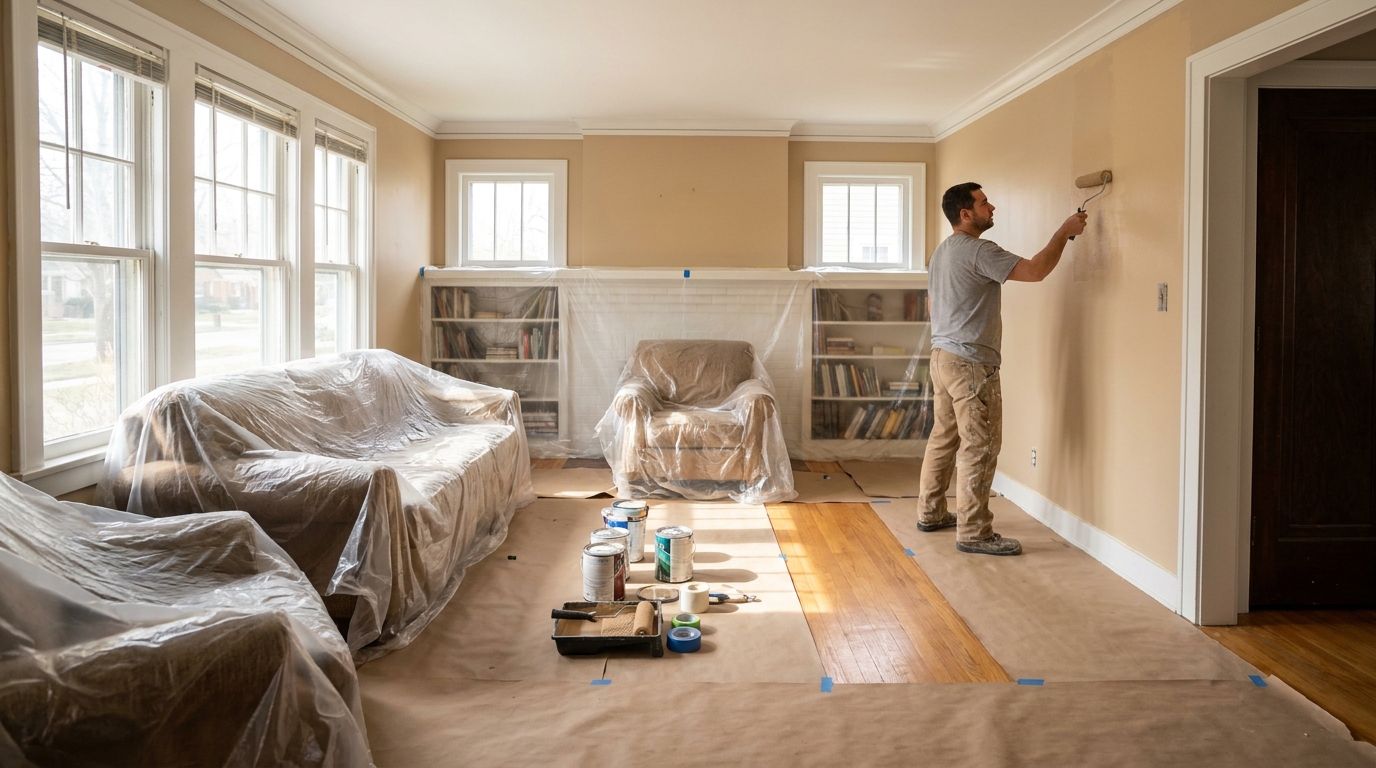
Refresh one room or coordinate a whole-home repaint with experienced professional painters serving Wayne, Oakland, and Macomb counties. We protect floors and furnishings, prepare each surface, apply the right primer and finish, and keep occupied Metro Detroit homes orderly throughout the project.
We discuss surface preparation, adjacent-area protection, products, colors, coats, access, and cleanup before work begins.
Service area
Interior service across Metro Detroit
Painting service across Wayne, Oakland & Macomb counties during posted business hours.
More about interior in Metro Detroit
Refresh one room or coordinate a whole-home repaint with experienced professional painters serving Wayne, Oakland, and Macomb counties. We protect floors and furnishings, prepare each surface, apply the right primer and finish, and keep occupied Metro Detroit homes orderly throughout the project. For each interior request, BH Painting Metro Detroit considers the substrate, preparation, property use, desired appearance, access, and cleanup requirements before finalizing scope.
We serve all of Metro Detroit for interior — Detroit, Dearborn, Warren, Sterling Heights, Troy, Livonia, Royal Oak, Farmington Hills, Pontiac, Southfield, Westland, Taylor, and every city in our coverage map. Project dates are discussed after we understand the scope and current schedule.
The cost of interior painting depends on the included surfaces, preparation, product selection, access, protection, and timing, so call (313) 236-4558 for a price on your job. Proposed scope changes should be discussed and documented before added work proceeds.
We document the agreed preparation, primer where needed, paint products, colors, sheen, surfaces, and closeout expectations so everyone is working from the same finish plan.
Plaster or drywall decides the preparation, and Metro Detroit has both
Interior walls in this area were built two different ways, and which one is behind the paint changes almost every step that follows. Houses raised before the Second World War, which is much of the older Detroit, Ferndale, Royal Oak, and Grosse Pointe housing stock, carry lime plaster over wood lath. Plaster moves with the season and opens fine settlement cracks at the corners of door and window openings; filling one with a soft lightweight compound and nothing else simply hides it until the next winter, so a crack that keeps coming back is opened out, bridged with tape or mesh, and feathered wide enough that the repair is not readable across the wall. Plaster that has lost its keys sounds hollow when tapped and has to be re-anchored to the lath before anything is skimmed over it. Post-war subdivisions across Livonia, Warren, Southfield, and Sterling Heights are drywall instead, where the recurring faults are fastener pops and ridged seams caused by seasonal movement in the framing; a pop is re-fastened beside the old screw rather than filled on its own, or it comes back. Both kinds of wall share the rest: glossy alkyd trim from earlier decades is deglossed and given a bonding primer before a waterborne finish will hold on it, patches are spot-primed or they flash duller than the wall around them, water and smoke staining wants a stain-blocking primer rather than another coat, and a textured ceiling has to be matched before it is coated. Coatings in a house built before 1978 may contain lead, and federal renovation rules govern how those surfaces may be disturbed, so the age of the house is established while the scope is written rather than once sanding has started.
A room-by-room repaint in a house nobody is moving out of
Most interior work here happens around people who are still cooking, sleeping, and working in the house, so the sequence matters as much as the coating. Ceilings are painted first, then walls, then trim and doors last, because every one of those stages would otherwise mark the surface finished before it. Rooms are taken a few at a time so the rest of the house stays usable, with furniture drawn to the middle and covered rather than carried out, floors protected by paper or canvas that stays put underfoot instead of sheeting that slides, and switch plates, vent covers, and door hardware taken off rather than cut around. The dust worth planning for is not paint but joint compound: sanding a repair produces the finest dust in the whole job, it travels through a house on its own, and vacuum-assisted sanding with the doorway sealed removes far more of it than cleaning up afterwards ever does. Cut lines at the ceiling and along the trim are made by hand, and they are what a repaint is judged on from the doorway. Two coats are normal, and the second one is usually about uniformity rather than hiding, because a single coat over a color change can cover and still read patchy in low-angle light. Low-odor waterborne products are chosen where a room will be slept in that night, and where a stain-blocking or alkali-resistant primer is genuinely required it goes on early in the day for the same reason. The last step is a walk with a light held at a shallow angle to the surface, which finds the misses that a lamp overhead does not.
What the heating season does to a wall, and why interiors carry a Michigan winter
Once the furnace starts running, a Michigan house becomes a different place to paint in. Indoor humidity falls steeply, often into the teens, and dry air pulls the water out of a waterborne coating faster than it comes out in July: the working edge stays open for less time, so a long wall is cut and rolled in stages that keep meeting a wet edge, or the overlaps turn up as darker bands once the light moves across them. Joint compound behaves the same way, drying quickly at the surface and shrinking as it goes, which is why a deep fill is built in more than one pass instead of one heavy one. Forced air keeps dust in motion the entire time the system is on, so registers in a room being coated are covered while a coat sets rather than after it. Drying and curing separate further in winter than people expect: a wall can be dry to the touch within the hour and still be weeks away from the hardness that lets it be washed or taped against, which is a reason not to schedule cleaning right behind a crew. Ventilation has to be arranged on purpose in a closed-up house, and daylight is short and flat enough by December that work lighting angled along the surface, rather than aimed at it, is what coverage actually gets judged by. Exterior painting in this climate closes out around October, which is precisely why interior work is what carries a winter here, across Oakland, Wayne, and Macomb County and in Royal Oak, Farmington Hills, Southfield, Sterling Heights, Rochester Hills, Livonia, Dearborn, and Detroit itself.
In depth
Questions about interior across Metro Detroit
Practical answers from BH Painting Metro Detroit to help you compare painting scopes in Metro Detroit. Tap a question to expand.
Preparation depends on the surface and its condition. A clear scope may include washing, scraping loose coating, sanding glossy areas, filling minor holes, caulking selected gaps, and protecting adjacent finishes. Existing damage or repairs outside the painting scope should be identified before work begins.
Primer is commonly used on bare or repaired surfaces, difficult stains, major color changes, and areas where adhesion needs help. A previously painted surface in sound condition may only need spot primer. The written scope should identify where primer is planned and why.
Flat and matte finishes reduce reflection but can be less washable. Eggshell and satin add washability and highlight more surface variation. Semi-gloss is often considered for trim, doors, and moisture-prone areas. Product-specific performance matters, so sheen should be selected with the room and substrate in mind.
Coat count depends on the existing color, new color, paint product, application method, and surface porosity. Strong color changes may require primer or additional finish coats. We recommend defining the planned coating system and the expected finished appearance instead of relying on a blanket promise.
Review a physical sample in the actual room or exterior area at different times of day. Light, surrounding finishes, and sheen all affect perception. Record the manufacturer, color name, color number, product, and sheen before materials are ordered.
Temperature, surface moisture, rain, wind, and direct sun can change application and drying conditions. Exterior dates may move when conditions fall outside the selected product's requirements. A responsible schedule protects the coating system instead of promising work in unsuitable weather.
The closeout plan should cover removal of masking and project debris, orderly storage or removal of labeled touch-up paint, and a walkthrough against the written scope. Any agreed touch-ups should be documented before the project is considered complete. Call (313) 236-4558 to discuss your project in Metro Detroit.
Planning a interior project?
Tell BH Painting Metro Detroit about the surfaces and finish you have in mind.