
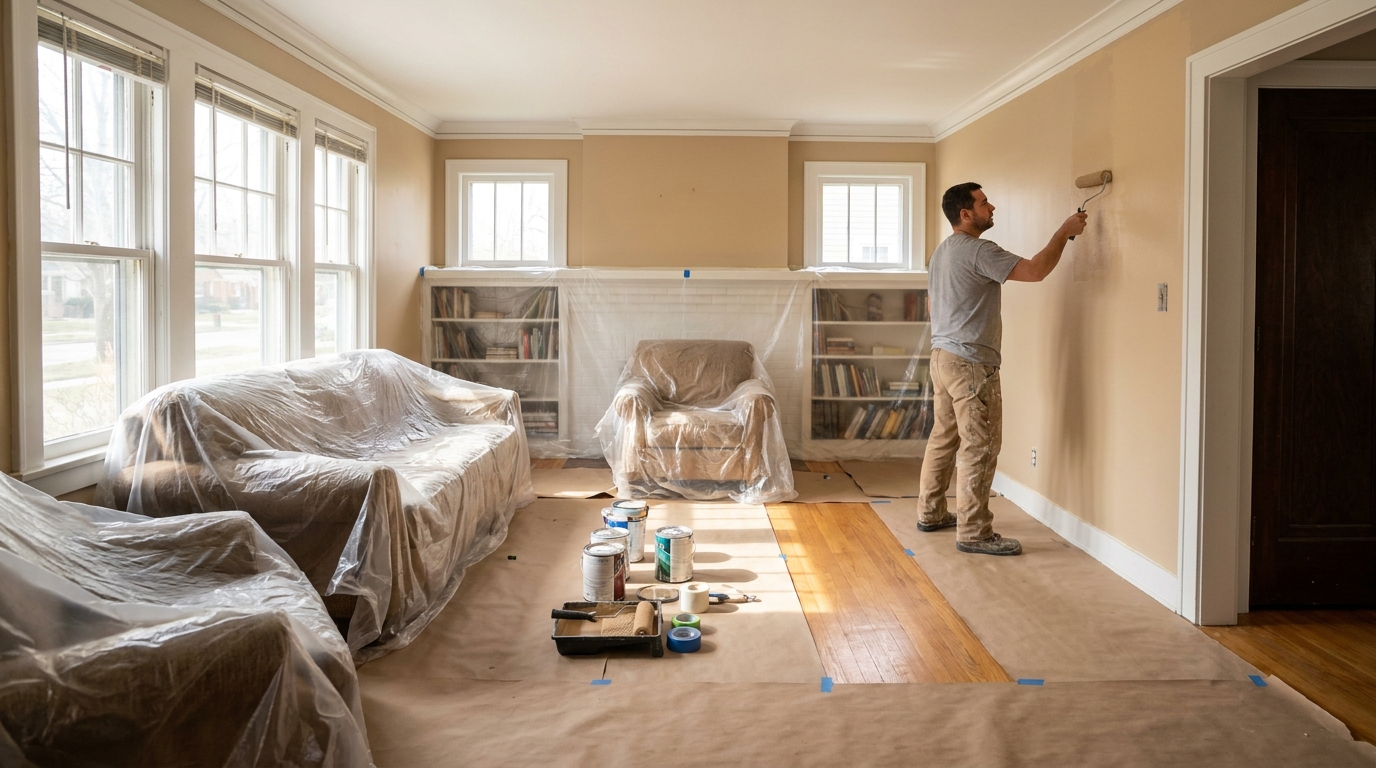
Painting services in Dearborn, MI
BH Painting Metro Detroit serves Dearborn with interior, exterior, cabinet, commercial, trim, ceiling, staining, rental turnover, wallpaper removal, and color consultation options.
Dearborn coverage
Map centered on Dearborn
Coordinates retained for this service-area page: 42.322°, -83.176°.
Painting services
Service options in Dearborn
Interior Painting in Dearborn
Clean lines, even coverage, and comfortable rooms from prep through final walk.
Exterior Painting in Dearborn
Weather-aware preparation and durable curb appeal for Michigan homes.
Cabinet Painting in Dearborn
A refined cabinet finish without the cost and disruption of full replacement.
Commercial Painting in Dearborn
Phased, professional painting that keeps customers, tenants, and teams moving.
Deck & Fence Staining in Dearborn
Preparation-first staining for outdoor wood exposed to Michigan seasons.
Trim & Door Painting in Dearborn
Crisp, durable finishes for the details people see and touch every day.
Ceiling Painting in Dearborn
Uniform, bright ceilings with careful protection below every work area.
Rental Turnover Painting in Dearborn
Reliable repaint schedules for rentals, apartments, and move-ready properties.
Wallpaper Removal in Dearborn
Methodical removal and paint-ready preparation without rushed shortcuts.
Color Consultation in Dearborn
Confident color and sheen choices grounded in your light, finishes, and goals.
Nearby service areas
Planning painting work in Dearborn
A useful first conversation starts with the surfaces and their current condition. Tell us whether the project involves occupied rooms, an empty turnover, exterior elevations, cabinets, trim, ceilings, commercial space, or outdoor wood.
Preparation may include cleaning, scraping, sanding, filling, caulking, spot priming, and protecting adjacent finishes. The appropriate steps depend on the substrate and should be described in the written scope rather than assumed.
Product, color, sheen, and coat decisions can affect appearance and schedule. Exterior timing also depends on suitable weather and the selected coating's application requirements.
Dearborn is a brick city, and that decides what an exterior job actually covers
The residential core here went up for Ford employees, most of it between roughly 1910 and 1940, and the dominant form is the brick bungalow, joined by Cape Cods, colonials, Tudors and the post-war ranches that filled in afterwards. On a full-masonry house the phrase exterior painting almost never means the walls. It means the wood wrapped around them: soffit and fascia, the frieze under the eaves, rake edges on the gable ends, porch ceilings, posts and rails, window sash and casings, storm and entry doors, and the detached garage that often carries more exposed wood than the house does. Those parts are narrow, high off the ground and take weather from every direction, so they fail years before the masonry needs anything at all, and they carry most of what a front elevation looks like from the sidewalk. Painting the brick itself is a separate question and close to a permanent one. Masonry has to be able to dry outward, and a film that seals the face can hold moisture inside the wall, which through a Michigan freeze-and-thaw winter is how the face of a brick pops off. Where a Dearborn house has already been coated at some point, the useful questions are what is underneath it and whether it is still bonded; where the brick is bare, leaving it bare and spending the work on the wood is usually the better answer. Mortar joints, the masonry sill course and the caps on porch walls are worth a look in the same walk, because no coating repairs a joint that is letting water in behind it.
The age of the housing settles the preparation before anything is sanded
A house that was standing before 1978 may carry coatings that contain lead, and federal renovation rules govern how those painted surfaces may be disturbed, so in a city built out this early the year of construction is established while the scope is being written rather than once a scraper is already on a window sill. Most of Dearborn's housing predates that date by decades, and exterior work on those houses lands on exactly the surfaces the rules speak to: sash, sills, porch rails, door casings and the eaves. The effect is on sequence and on how a surface is taken back, not on whether the work can be done. Age has a second consequence. Wood on a century-old bungalow has usually been coated many times over, oil-based for the first several decades of that, so a waterborne finish is going onto a surface that wants de-glossing and an adhesion check rather than only a wash. Coating build-up along the edges of sash and casing is normal on a house of that vintage, and those edges are feathered back so the trim profile reads the way it was milled instead of drowning under one more layer. Bare wood uncovered under a failed coat is spot-primed the same day it is exposed, because Michigan humidity gets into open grain overnight and takes the new primer with it when it goes.
One part of Dearborn has its exterior appearance written into a city resolution
Between 1919 and 1921 Ford Motor Company built 250 houses just west of downtown Dearborn for employees of the nearby tractor plant, in six repeating designs by the architect Albert Wood. The first 94 went up on Park and Nona in 1919; the remaining 156 followed on Beech, Edison, Francis, Gregory and Military, inside the area bounded by the Michigan Central Railroad tracks, Military, Nowlin and Monroe. That neighborhood is the Ford Homes Historic District, and Dearborn City Council established it by resolution in 1979 specifically to preserve the exterior appearance of the houses. For a painting project the consequence is a scheduling one rather than a design one: inside the district, exterior color and anything that alters a detail a passer-by can see are worth confirming against the district's own preservation guidance before materials are ordered, not after the first elevation has been coated. That belongs at the planning stage, which is why the address matters as much as the surface list when you first get in touch. Beyond the boundary the same six designs continue across the surrounding streets with no such review, so it is the boundary rather than the style of the house that decides whether the question needs asking.
Share the project address and preferred timing through the contact form so we can confirm coverage in Dearborn and discuss next steps.
In depth
Questions about painting in Dearborn
Practical answers from BH Painting Metro Detroit to help you compare painting scopes in Dearborn. Tap a question to expand.
Preparation depends on the surface and its condition. A clear scope may include washing, scraping loose coating, sanding glossy areas, filling minor holes, caulking selected gaps, and protecting adjacent finishes. Existing damage or repairs outside the painting scope should be identified before work begins.
Primer is commonly used on bare or repaired surfaces, difficult stains, major color changes, and areas where adhesion needs help. A previously painted surface in sound condition may only need spot primer. The written scope should identify where primer is planned and why.
Flat and matte finishes reduce reflection but can be less washable. Eggshell and satin add washability and highlight more surface variation. Semi-gloss is often considered for trim, doors, and moisture-prone areas. Product-specific performance matters, so sheen should be selected with the room and substrate in mind.
Coat count depends on the existing color, new color, paint product, application method, and surface porosity. Strong color changes may require primer or additional finish coats. We recommend defining the planned coating system and the expected finished appearance instead of relying on a blanket promise.
Review a physical sample in the actual room or exterior area at different times of day. Light, surrounding finishes, and sheen all affect perception. Record the manufacturer, color name, color number, product, and sheen before materials are ordered.
Temperature, surface moisture, rain, wind, and direct sun can change application and drying conditions. Exterior dates may move when conditions fall outside the selected product's requirements. A responsible schedule protects the coating system instead of promising work in unsuitable weather.
The closeout plan should cover removal of masking and project debris, orderly storage or removal of labeled touch-up paint, and a walkthrough against the written scope. Any agreed touch-ups should be documented before the project is considered complete. Call (313) 236-4558 to discuss your project in Dearborn.
Have a painting project in Dearborn?
Tell BH Painting Metro Detroit what you would like painted.