 BH Painting Metro Detroit · Metro Detroit painting Sun–Fri service All of Metro Detroit
Commercial
Commercial Painting
Phased, professional painting that keeps customers, tenants, and teams moving.
Is your commercial project in our service area?
Location access only checks whether you appear to be within our Metro Detroit coverage bounds. It does not promise project availability, a start date, or an arrival time.
What's included
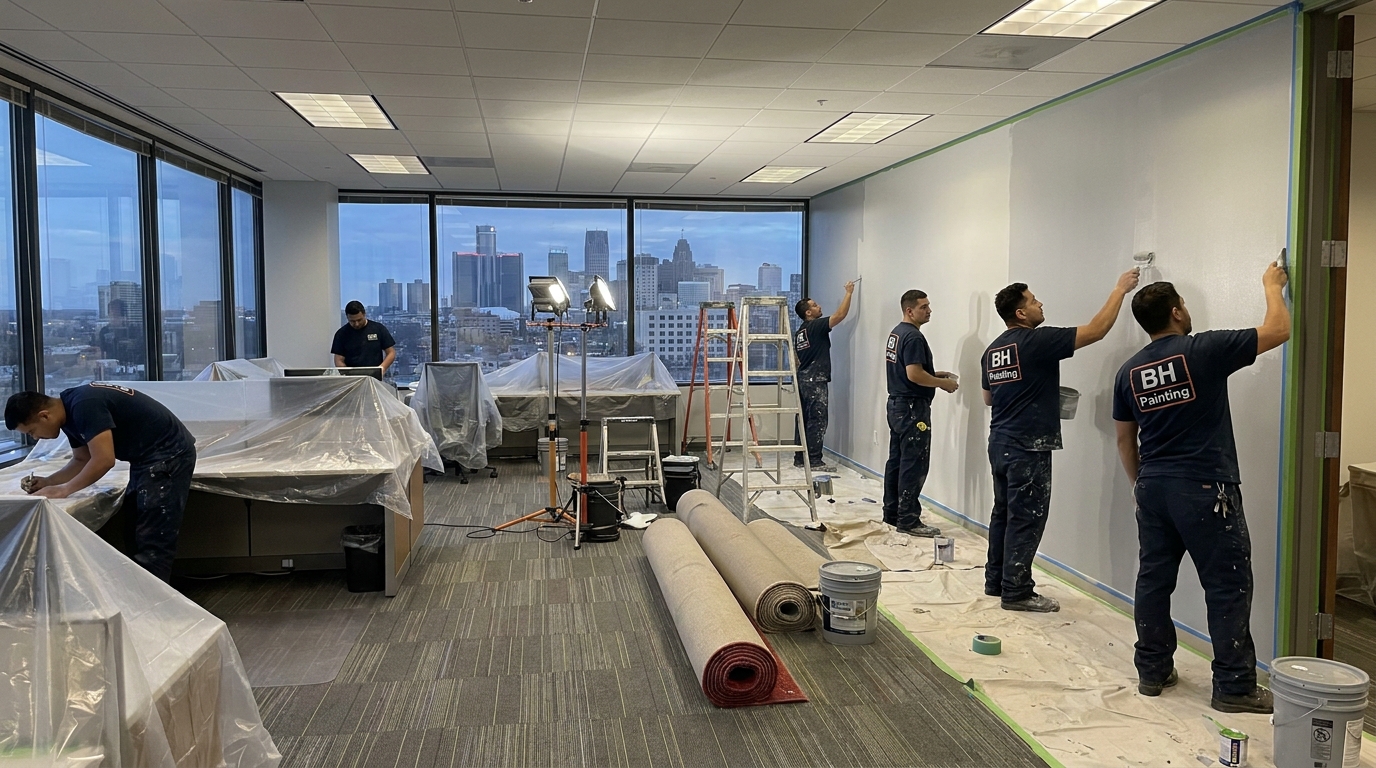
Commercial painting across Oakland, Wayne and Macomb County: offices, retail spaces, restaurants, common areas, and light-industrial interiors. Property managers and business owners across Metro Detroit use our commercial painting crews. We coordinate access, protection, work zones, and cure times around operations, with clear scopes and progress communication.
We discuss surface preparation, adjacent-area protection, products, colors, coats, access, and cleanup before work begins.
Service area
Commercial service across Metro Detroit
Painting service across Wayne, Oakland & Macomb counties during posted business hours.
More about commercial in Metro Detroit
Commercial painting across Oakland, Wayne and Macomb County: offices, retail spaces, restaurants, common areas, and light-industrial interiors. Property managers and business owners across Metro Detroit use our commercial painting crews. We coordinate access, protection, work zones, and cure times around operations, with clear scopes and progress communication. For each commercial request, BH Painting Metro Detroit considers the substrate, preparation, property use, desired appearance, access, and cleanup requirements before finalizing scope.
We serve all of Metro Detroit for commercial — Detroit, Dearborn, Warren, Sterling Heights, Troy, Livonia, Royal Oak, Farmington Hills, Pontiac, Southfield, Westland, Taylor, and every city in our coverage map. Project dates are discussed after we understand the scope and current schedule.
The cost of commercial painting depends on the included surfaces, preparation, product selection, access, protection, and timing, so call (313) 236-4558 for a price on your job. Proposed scope changes should be discussed and documented before added work proceeds.
We document the agreed preparation, primer where needed, paint products, colors, sheen, surfaces, and closeout expectations so everyone is working from the same finish plan.
Commercial interior repainting while the space stays in use
Most commercial interior work is a repaint rather than a first coat, and the wall tells you what it has been through. Corridors and lobbies collect scuffs and cart impact at hip height, suites carry patched anchor holes where shelving and monitors moved, and the wall areas beside entries hold grime that will telegraph through a fresh coat if it is painted over rather than washed off first. Long runs of linear ceiling lighting rake across a commercial wall and show every skim that was not feathered, so patching here is judged under the building's own lights rather than by daylight. Sheen matters more than it does in a house: a flat wall in a busy corridor cannot be cleaned without burnishing, which is why washable eggshell and satin finishes carry most commercial wall areas while semi-gloss goes on the doors, frames, and trim that hands actually touch. Device plates, data drops, thermostats, sprinkler heads, and signage are masked or removed rather than cut around, because the cut line is the part a tenant looks at from a desk all day.
Office buildings, retail, and multi-tenant common areas
A building with tenants in it is a sequencing problem before it is a painting problem. Common areas run on the building's traffic rather than on ours, so corridors, stairwells, elevator lobbies, and restrooms are usually broken into zones that can be closed one at a time and handed back in service. Suite turnover between leases is the opposite case, an empty space with a hard date on it, where the work is wall repair, a repaint to the building standard color, and doors and frames returned to their original finish. Where a property already has a standard, we match the existing specification rather than proposing a new one; where it does not, the color and sheen schedule is written down so the next repaint has something to follow. Stairwells, atrium walls, and high retail ceilings need their elevated access planned before the crew arrives rather than improvised on the day. Scope, zones, and the order of work are agreed with property management or the building engineer before the first area is protected, and progress is reported against that plan.
Commercial exteriors across Oakland, Wayne, and Macomb counties
Commercial exteriors in Michigan are mostly masonry, block, and metal rather than the wood and lap siding on a house, and each substrate wants its own system. Split-face and concrete block are porous and take a block filler or masonry primer before any finish coat, or the texture drinks the material and dries patchy. Painted brick and stucco hold moisture and want a breathable coating so vapor can leave the wall instead of pushing the film off in spring. Doors, frames, railings, canopies, and dock surrounds need rust taken back to sound metal and a primer suited to what is underneath, because a topcoat laid over scale lets go at the first freeze cycle. The season is set by surface temperature and dew point rather than by the calendar: a fifty degree October afternoon can still be too cold on a north elevation that never sees sun, and coating a wall that is about to drop below its dew point traps moisture under the film. That is why commercial exterior dates here are confirmed close to the day rather than months ahead. The commercial work we see runs through Pontiac and the Woodward corridor, the Southfield office parks, Farmington Hills, and Detroit, all inside the Wayne, Oakland, and Macomb county area we cover.
In depth
Questions about commercial across Metro Detroit
Practical answers from BH Painting Metro Detroit to help you compare painting scopes in Metro Detroit. Tap a question to expand.
Preparation depends on the surface and its condition. A clear scope may include washing, scraping loose coating, sanding glossy areas, filling minor holes, caulking selected gaps, and protecting adjacent finishes. Existing damage or repairs outside the painting scope should be identified before work begins.
Primer is commonly used on bare or repaired surfaces, difficult stains, major color changes, and areas where adhesion needs help. A previously painted surface in sound condition may only need spot primer. The written scope should identify where primer is planned and why.
Flat and matte finishes reduce reflection but can be less washable. Eggshell and satin add washability and highlight more surface variation. Semi-gloss is often considered for trim, doors, and moisture-prone areas. Product-specific performance matters, so sheen should be selected with the room and substrate in mind.
Coat count depends on the existing color, new color, paint product, application method, and surface porosity. Strong color changes may require primer or additional finish coats. We recommend defining the planned coating system and the expected finished appearance instead of relying on a blanket promise.
Review a physical sample in the actual room or exterior area at different times of day. Light, surrounding finishes, and sheen all affect perception. Record the manufacturer, color name, color number, product, and sheen before materials are ordered.
Temperature, surface moisture, rain, wind, and direct sun can change application and drying conditions. Exterior dates may move when conditions fall outside the selected product's requirements. A responsible schedule protects the coating system instead of promising work in unsuitable weather.
The closeout plan should cover removal of masking and project debris, orderly storage or removal of labeled touch-up paint, and a walkthrough against the written scope. Any agreed touch-ups should be documented before the project is considered complete. Call (313) 236-4558 to discuss your project in Metro Detroit.
Planning a commercial project?
Tell BH Painting Metro Detroit about the surfaces and finish you have in mind.